
Bolivia
Bolivia straddles the Andes, with Lake Titicaca in the west and broad lowlands stretching east toward Brazil.
- Capital
- Sucre
- Region
- South America
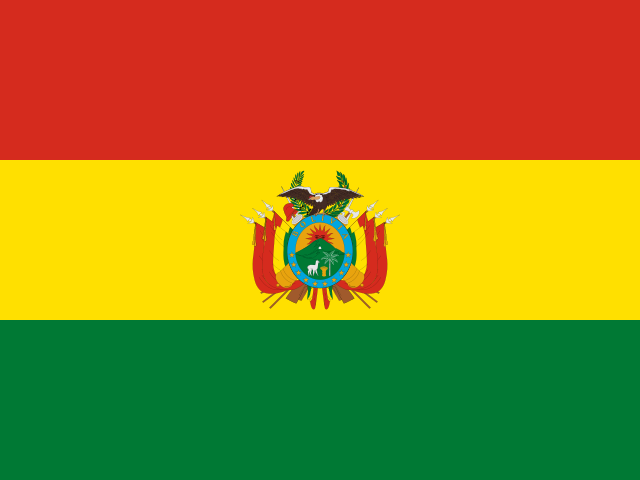
Flag of Bolivia
Red stands for bravery and the blood of national heroes, yellow for the nation's mineral resources, and green for the fertility of the land.
Bolivia and Ghana share red–yellow–green from top to bottom. Bolivia adds a coat of arms where Ghana puts a black star.
Compare with Ghana · Ethiopia · Burkina Faso.
Languages and local life
Where the name comes from The country is named after Simón BOLÍVAR, a 19th-century leader in the South American wars for independence.
Language profile Spanish (official) 68.1%, Quechua (official) 17.2%, Aymara (official) 10.5%, Guarani (official) 0.6%, other 1.5%, unspecified 2.1%; note - Spanish and all Indigenous languages are official (2012 est.).
Currency Bolivian boliviano (BOB).
Borders and landscape
Area and borders Total area is about 1,098,581 km². It shares land borders with Argentina, Brazil, Chile, Paraguay and Peru.
Landscape Rugged Andes Mountains with a highland plateau (Altiplano), hills, lowland plains of the Amazon Basin.
From high to low Highest point: Nevado Sajama 6,542 m. Lowest point: Rio Paraguay 90 m.
Where it is
On the map Bolivia straddles the Andes, with Lake Titicaca in the west and broad lowlands stretching east toward Brazil.
Where people live A high altitude plain in the west between two cordillera of the Andes, known as the Altiplano, is the focal area for most of the population; a dense settlement pattern is also found in and around the city of Santa Cruz, located on the eastern side of the Andes.
A person connected to this country
Profile Juan Evo Morales Ayma (Spanish: [xwan ˈeβo moˈɾales ˈajma]; born 26 October 1959) is a Bolivian politician, trade union organizer, and former cocalero activist who served as the 65th President of Bolivia from 2006 to 2019. Widely regarded as the country's first president to come from its indigenous population, his administration focused on the implementation of leftist policies and combating the influence of the United States and multinational corporations.
From the biography “Growing coca and becoming a trade unionist, he rose to prominence in the campesino ("rural laborers") union.”