
Burkina Faso
Burkina Faso spans part of the inland Sahel between Ghana's northern border and Mali.
- Capital
- Ouagadougou
- Region
- Western Africa
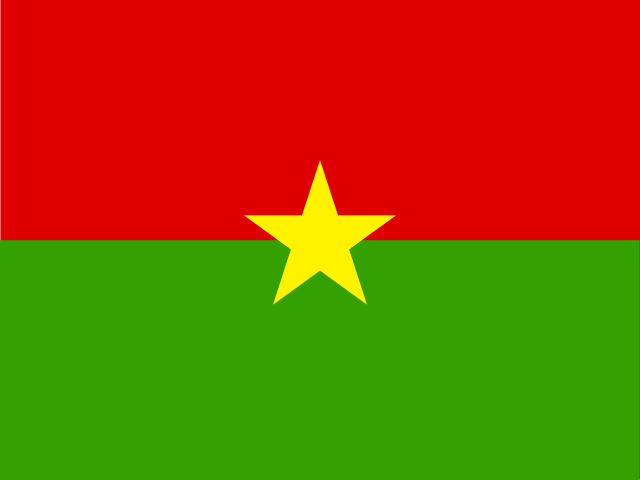
Flag of Burkina Faso
Red recalls the country's struggle for independence, green is for hope and abundance, and yellow represents the country's mineral wealth.
One gold star bridges a red top and green bottom. Morocco keeps the whole field red and draws its star in green.
Compare with Ghana · Ethiopia · Bolivia · Morocco · Cameroon · Senegal.
Languages and local life
Where the name comes from Name translates as "Land of the Honest (Incorruptible) Men".
Language profile Mossi 52.9%, Fula 7.8%, Gourmantche 6.8%, Dyula 5.7%, Bissa 3.3%, Gurunsi 3.2%, French (official) 2.2%, Bwamu 2%, Dagara 2%, San 1.7%, Marka 1.6%, Bobo 1.5%, Senufo 1.5%, Lobi 1.2%, other 6.6% (2019 est.).
Currency West African CFA franc (XOF).
Borders and landscape
Area and borders Total area is about 272,967 km². It shares land borders with Benin, Ivory Coast, Ghana, Mali, Niger and Togo.
Landscape Mostly flat to dissected, undulating plains; hills in the west and southeast; occupies an extensive plateau with savanna that is grassy in the north and gradually gives way to sparse forests in the south.
From high to low Highest point: Tena Kourou 749 m. Lowest point: Mouhoun (Black Volta) River 200 m.
Where it is
On the map Burkina Faso spans part of the inland Sahel between Ghana's northern border and Mali.
Where people live Most of the population is located in the center and south. Nearly one-third of the population lives in cities. The capital and largest city is Ouagadougou (Ouaga), with a population of 1.8 million as shown in this population distribution map (2019).
A person connected to this country
Profile Thomas Isidore Noël Sankara (21 December 1949 – 15 October 1987) was a Burkinabé military officer, politician, Marxist and pan-Africanist revolutionary who served as the first president of Burkina Faso from 1983 until his assassination in 1987. Sankara previously served as the fifth prime minister of Upper Volta from January to May 1983.
From the biography “In 1984, Sankara oversaw the renaming of the country as Burkina Faso ('land of the upright people'), and personally wrote its national anthem.”