
Canada
Canada spans northern North America from the Atlantic to the Pacific and north to the Arctic, with Hudson Bay cutting far into the continent.
- Capital
- Ottawa
- Region
- North America
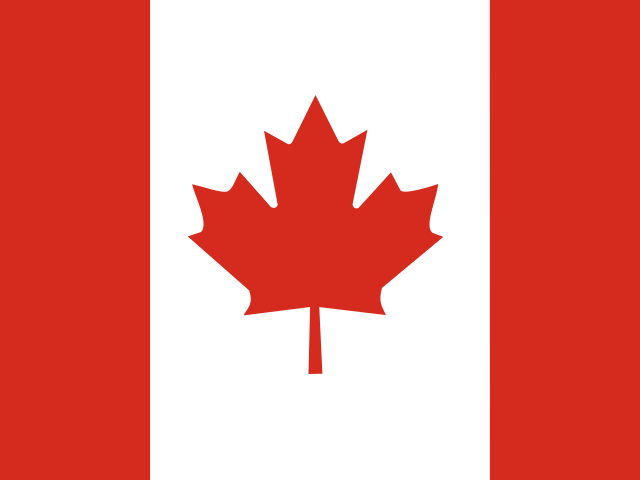
Flag of Canada
Canada first raised this flag in 1965. The original proposal had a 13-point maple leaf. Its outline lost detail at a distance, so graphic artist Jacques St-Cyr simplified the leaf to 11 points.
Canada and Peru both have red sides around white. Canada has a single large maple leaf in the middle.
Languages and local life
Where the name comes from The country name likely derives from the St. Lawrence Iroquoian word "kanata" meaning village or settlement.
Language profile English (official) 87.1%, French (official) 29.1%, Chinese languages 4.2%, Spanish 3.2%, Punjabi 2.6%, Arabic 2.4%, Tagalog 2.3%, Italian 1.5% (2022 est.).
Currency Canadian dollar (CAD).
Borders and landscape
Area and borders Total area is about 9,984,670 km². It shares land borders with United States.
Landscape Mostly plains with mountains in west, lowlands in southeast.
From high to low Highest point: Mount Logan 5,959 m. Lowest point: Atlantic/Pacific/Arctic Oceans 0 m.
A moment in its history
The event The Province of Canada, Nova Scotia and New Brunswick united as the Dominion of Canada on 1 July 1867.
The wider story The arithmetic follows the political reorganisation: the three joining provinces did not remain three identical units. Confederation combined a union with a division, producing Ontario, Quebec, Nova Scotia and New Brunswick.
Three joined, four emerged The Province of Canada split into Ontario and Quebec as it joined Nova Scotia and New Brunswick in the new federation.
A person connected to this country
What they contributed “for her bold and inventive oeuvre that, in playful dialogue with the classical tradition, has created new forms for contemporary literature”
The person Anne Carson, born in Toronto, received the 2026 Nobel Prize in Literature.
Where it is
On the map Canada spans northern North America from the Atlantic to the Pacific and north to the Arctic, with Hudson Bay cutting far into the continent.
Where people live Vast majority of Canadians are positioned in a discontinuous band within approximately 300 km of the southern border with the United States; the most populated province is Ontario, followed by Quebec and British Columbia.