
Peru
Peru connects three contrasting settings: an arid Pacific coast, the Andes, and eastern slopes whose rivers enter the Amazon basin. Machu Picchu sits high above the Urubamba Valley within the mountain setting.
- Capital
- Lima
- Region
- South America
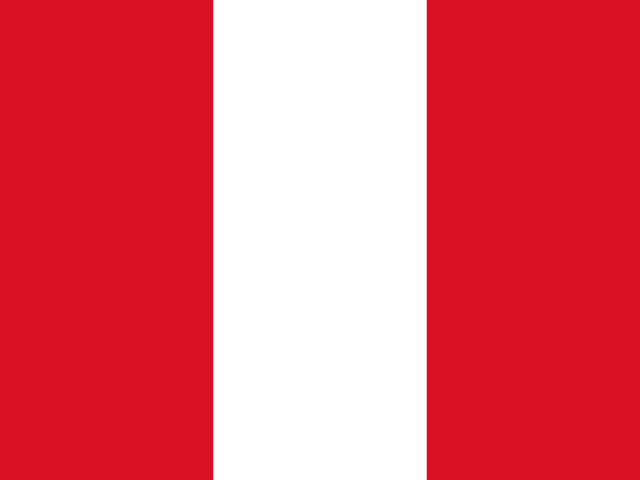
Flag of Peru
The coat of arms features a shield bearing a vicuna (representing fauna), a cinchona tree (the source of quinine, signifying flora), and a yellow cornucopia spilling out coins (denoting mineral wealth).
Think Canada without the maple leaf. Peru uses red sides and, in this version, a blank white middle.
Languages and local life
Where the name comes from Exact meaning is obscure, but the name may derive from a native word "biru" meaning "river".
Language profile Spanish (official) 82.9%, Quechua (official) 13.6%, Aymara (official) 1.6%, Ashaninka 0.3%, other native languages (includes many minor Amazonian languages) 0.8%, other 0.2%, none 0.1%, unspecified 0.7% (2017 est.).
Currency Peruvian sol (PEN).
Borders and landscape
Area and borders Total area is about 1,285,216 km². It shares land borders with Bolivia, Brazil, Chile, Colombia and Ecuador.
Landscape Western coastal plain (costa), high and rugged Andes in center (sierra), eastern lowland jungle of Amazon Basin (selva).
From high to low Highest point: Nevado Huascaran 6,746 m. Lowest point: Pacific Ocean 0 m.
A moment in its history
The event The Peruvian War of Independence led to Peru’s emergence as an independent state on 28 July 1821.
The wider story The wider conflicts ran from 1809 to 1826, and disputes over sovereignty continued beyond the declaration. Ayacucho belongs to the military timeline, while 28 July 1821 marks the political announcement commemorated as independence.
From declaration to battlefield The independence proclamation came in 1821. Victory at Ayacucho followed three years later and secured Peru’s independence from Spain.
A person connected to this country
What they contributed “for his cartography of structures of power and his trenchant images of the individual's resistance, revolt, and defeat”
The person Mario Vargas Llosa, born in Arequipa, received the 2010 Nobel Prize in Literature.
Where it is
On the map Peru connects three contrasting settings: an arid Pacific coast, the Andes, and eastern slopes whose rivers enter the Amazon basin. Machu Picchu sits high above the Urubamba Valley within the mountain setting.
Where people live Approximately one-third of the population resides along the desert coastal belt in the west, with a strong focus on the capital city of Lima; the Andean highlands, or sierra, which is strongly identified with the country's Amerindian population, contains roughly half of the overall population; the eastern slopes of the Andes, and adjoining rainforest, are sparsely populated.