
Lebanon
Lebanon occupies a narrow strip of the eastern Mediterranean with the Bekaa between the Lebanon and Anti-Lebanon mountains.
- Capital
- Beirut
- Region
- Western Asia
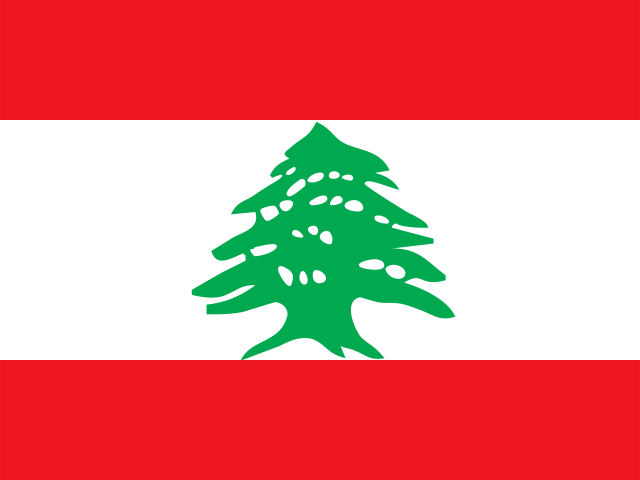
Flag of Lebanon
The green cedar is Lebanon’s emblem and recalls its historic cedar forests.
The broad white stripe holds a green cedar. Austria leaves the white stripe empty and gives it the same width as the red ones.
Languages and local life
Where the name comes from Derives from the Semitic root "lbn" meaning "white" and refers to snow-capped Mount Lebanon.
Language profile Arabic (official), French, English, Armenian.
Currency Lebanese pound (LBP).
Borders and landscape
Area and borders Total area is about 10,452 km². It shares land borders with Israel and Syria.
Landscape Narrow coastal plain; El Beqaa (Bekaa Valley) separates Lebanon and Anti-Lebanon Mountains.
From high to low Highest point: Qornet es Saouda 3,088 m. Lowest point: Mediterranean Sea 0 m.
A person connected to this country
What they contributed “for their discoveries of receptors for temperature and touch”
The person Ardem Patapoutian, born in Beirut, received the 2021 Nobel Prize in Physiology or Medicine.
Where they worked Scripps Research and Howard Hughes Medical Institute at the time of the award.
Where it is
On the map Lebanon occupies a narrow strip of the eastern Mediterranean with the Bekaa between the Lebanon and Anti-Lebanon mountains.
Where people live The majority of the people live on or near the Mediterranean coast, and of these most live in and around the capital, Beirut; favorable growing conditions in the Bekaa Valley, on the southeastern side of the Lebanon Mountains, have attracted farmers and thus the area exhibits a smaller population density.