
China
China connects the heights of the Tibetan Plateau with lowlands along the Pacific, linked by rivers including the Yangtze.
- Capital
- Beijing
- Region
- Eastern Asia
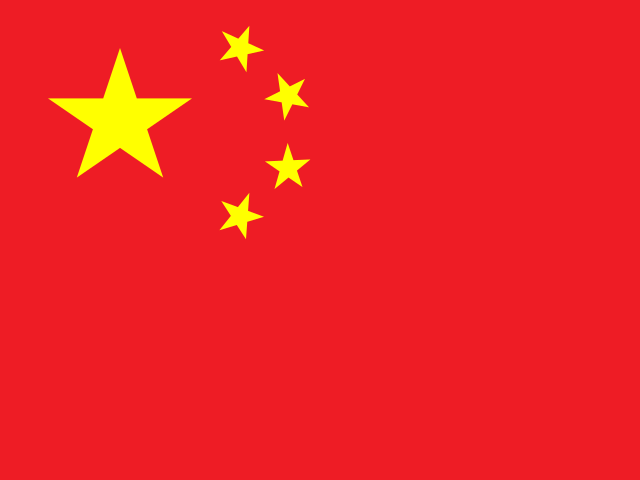
Flag of China
The large star represents the Communist Party of China. The four smaller stars represent the people united around it.
Count the stars and check the corner. China has one big star and four little ones there. Vietnam has one in the centre.
Compare with Vietnam · Kyrgyzstan.
Languages and local life
Where the name comes from English name derives from the Qin (Chin) rulers of the 3rd century B.C., who comprised the first imperial dynasty of ancient China; the Chinese name Zhongguo translates as "Central Nation" or "Middle Kingdom".
Language profile Standard Mandarin (Putonghua), based on the Beijing dialect, is the national standard. The archive also records Cantonese, Shanghainese, Hokkien and Hakka among the varieties spoken.
Currency Chinese yuan (CNY).
Borders and landscape
Area and borders Total area is about 9,706,961 km².
Landscape Mostly mountains, high plateaus, deserts in west; plains, deltas, and hills in east.
From high to low Highest point: Mount Everest (highest peak in Asia and highest point on earth above sea level) 8,849 m. Lowest point: Turpan Pendi (Turfan Depression) -154 m.
A moment in its history
The event Mao Zedong proclaimed the People’s Republic of China in Tiananmen Square, Beijing, on 1 October 1949.
The wider story The proclamation ceremony marked the foundation of contemporary China.
At the ceremony The new flag was raised and “March of the Volunteers” played at the ceremony in Tiananmen Square.
A person connected to this country
What they contributed “for her discoveries concerning a novel therapy against Malaria”
The person Tu Youyou, born in Zhejiang Ningbo, received the 2015 Nobel Prize in Physiology or Medicine.
Where they worked China Academy of Traditional Chinese Medicine at the time of the award.
Where it is
On the map China connects the heights of the Tibetan Plateau with lowlands along the Pacific, linked by rivers including the Yangtze.
Where people live Overwhelming majority of the population is found in the eastern half of the country; the west, with its vast mountainous and desert areas, remains sparsely populated; though ranked first in the world in total population, overall density is less than that of many other countries in Asia and Europe; high population density is found along the Yangtze and Yellow River valleys, the Xi Jiang River delta, the Sichuan Basin (around Chengdu), in and around Beijing, and the industrial area around Shenyang.