
Kyrgyzstan
Kyrgyzstan is an inland Central Asian country whose Tian Shan ranges surround high lakes including Issyk-Kul.
- Capital
- Bishkek
- Region
- Central Asia
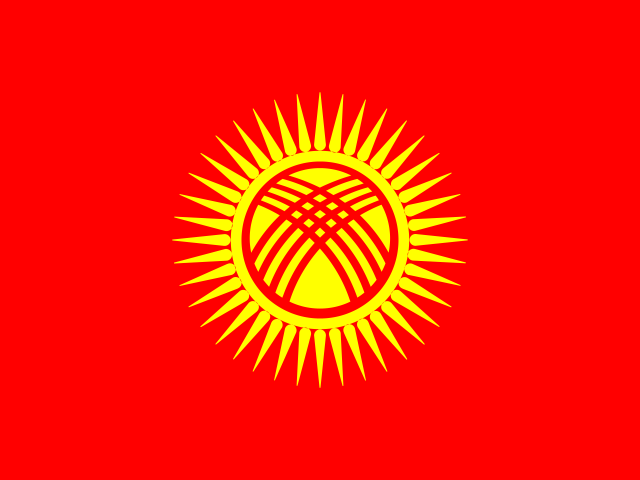
Flag of Kyrgyzstan
Red field with a yellow sun in the center having 40 rays representing the 40 Kyrgyz tribes.
There is a roof pattern inside the gold sun. Vietnam has a plain star on red and North Macedonia stretches its rays to the edges.
Languages and local life
Where the name comes from A combination of the Turkic words "kyrg" (forty) and "-yz" (tribes) with the Persian suffix "-stan" (country) creating the meaning "Land of the Forty Tribes"; the name refers to the 40 clans united by the mythic Kyrgyz hero, MANAS.
Language profile Kyrgyz (state language) 71.4%, Uzbek 14.4%, Russian (official language) 9%, other 5.2% (2009 est.).
Currency Kyrgyzstani som (KGS).
Food traditions
The tradition Families and neighbours make flatbread together, sharing tasks from mixing the dough to baking. The bread is served at gatherings and life events, where sharing it can express hospitality or solidarity.
Three ways to bake The same practice can call for an earth oven, a metal plate or a cauldron. The equipment varies across the communities that share the tradition.
Borders and landscape
Area and borders Total area is about 199,951 km². It shares land borders with China, Kazakhstan, Tajikistan and Uzbekistan.
Landscape Peaks of the Tien Shan mountain range and associated valleys and basins encompass the entire country.
From high to low Highest point: Jengish Chokusu (Pik Pobedy) 7,439 m. Lowest point: Kara-Daryya (Karadar'ya) 132 m.
Where it is
On the map Kyrgyzstan is an inland Central Asian country whose Tian Shan ranges surround high lakes including Issyk-Kul.
Where people live The vast majority of Kyrgyzstanis live in rural areas; densest population settlement is to the north in and around the capital, Bishkek, followed by Osh in the west; the least densely populated area is the east, southeast in the Tien Shan mountains.
A person connected to this country
Two mother tongues Chingiz Aitmatov described Kyrgyz and Russian as equally his mother tongues. Growing up with both informed his belief that a child can learn two languages side by side.
Why languages matter Writing for the UNESCO Courier, Aitmatov argued that minority languages are part of humanity’s heritage. He also saw exchange with other cultures as essential to the life of a national culture.