
Vietnam
Vietnam's narrow coastal shape links two major delta regions: the Red River in the north and the Mekong in the south. The Mekong reaches southern Vietnam after crossing from Cambodia, then divides into branches before reaching the sea. A river can therefore connect neighbouring countries even when its delta is most closely associated with just one of them.
- Capital
- Hanoi
- Region
- South-Eastern Asia
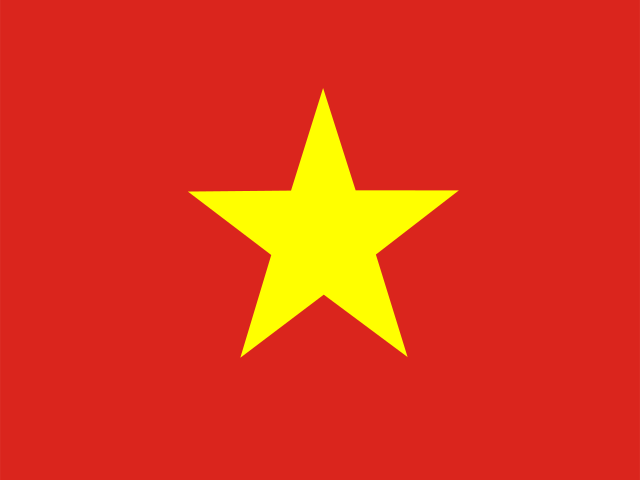
Flag of Vietnam
The five points of the yellow star represent workers, farmers, soldiers, intellectuals and young people.
One gold star in the centre. China puts a cluster of five in a corner and Kyrgyzstan has a sun with a pattern inside.
Compare with China · Kyrgyzstan.
Languages and local life
Where the name comes from "Viet nam" translates as "Viet south," where "Viet" is an ethnic self identification dating to a second century B.C. kingdom and "nam" refers to its location in relation to other Viet kingdoms.
Language profile Vietnamese (official); English (often as a second language); some French, Chinese, and Khmer; mountain-area languages (including Mon-Khmer and Malayo-Polynesian).
Currency Vietnamese đồng (VND).
Borders and landscape
Area and borders Total area is about 331,212 km². It shares land borders with Cambodia, China and Laos.
Landscape Low, flat delta in south and north; central highlands; hilly, mountainous in far north and northwest.
From high to low Highest point: Fan Si Pan 3,144 m. Lowest point: South China Sea 0 m.
A moment in its history
The event Ho Chi Minh declared the establishment of the Democratic Republic of Vietnam in Hanoi on 2 September 1945.
The wider story This followed the August Revolution, which took place from 16 to 30 August 1945.
From a front to a revolution The Viet Minh formed in 1941 around the goal of independence and led the August Revolution four years later.
A person connected to this country
What they contributed “for jointly having negotiated a cease fire in Vietnam in 1973”
The person Le Duc Tho , born in Nam Ha province, received the 1973 Nobel Prize in Peace.
Where it is
On the map Vietnam's narrow coastal shape links two major delta regions: the Red River in the north and the Mekong in the south. The Mekong reaches southern Vietnam after crossing from Cambodia, then divides into branches before reaching the sea. A river can therefore connect neighbouring countries even when its delta is most closely associated with just one of them.
Where people live Though it has one of the highest population densities in the world, the population is not evenly dispersed; clustering is heaviest along the South China Sea and Gulf of Tonkin, with the Mekong Delta (in the south) and the Red River Valley (in the north) having the largest concentrations of people.