
Cuba
Cuba is the large island across the Florida Strait, with the Sierra Maestra rising near its eastern end.
- Capital
- Havana
- Region
- Caribbean
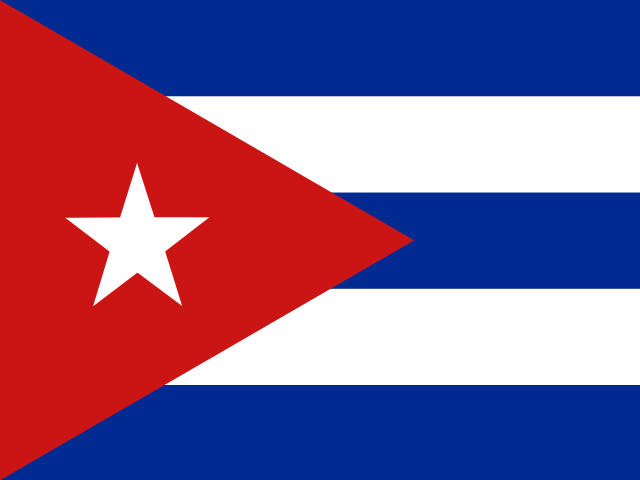
Flag of Cuba
The blue bands refer to the three old divisions of the island: central, occidental, and oriental.
Cuba has blue stripes and a red triangle. Puerto Rico swaps those colours: red stripes, blue triangle.
Compare with Djibouti · São Tomé and Príncipe · Timor-Leste.
Languages and local life
Where the name comes from Name derives from the Taino Indian designation for the island "coabana" meaning "great place".
Language profile Spanish (official).
Currency Cuban convertible peso (CUC) and Cuban peso (CUP).
Borders and landscape
Area and borders Total area is about 109,884 km².
Landscape Mostly flat to rolling plains, with rugged hills and mountains in the southeast.
From high to low Highest point: Pico Turquino 1,974 m. Lowest point: Caribbean Sea 0 m.
Where it is
On the map Cuba is the large island across the Florida Strait, with the Sierra Maestra rising near its eastern end.
Where people live Large population clusters found throughout the country, the more significant ones being in the larger towns and cities, particularly the capital of Havana.
A person connected to this country
Profile Fidel Alejandro Castro Ruz (13 August 1926 – 25 November 2016) was a Cuban revolutionary and politician who was the leader of Cuba from 1959 to 2011. He served as prime minister from 1959 to 1976, president from 1976 to 2008, and first secretary of the Communist Party of Cuba from 1965 until 2011.
From the biography “Born in Birán, the son of a wealthy Spanish farmer, Castro adopted leftist and anti-imperialist ideas while studying law at the University of Havana.”