
São Tomé and Príncipe
São Tomé and Príncipe sits off Central Africa, with the smaller island of Príncipe to the northeast of São Tomé.
- Capital
- São Tomé
- Region
- Middle Africa
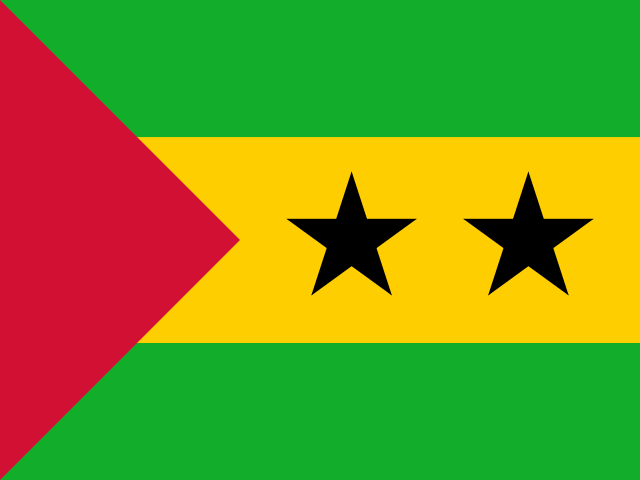
Flag of São Tomé and Príncipe
Green stands for the country's rich vegetation, red recalls the struggle for independence, and yellow represents cocoa, one of the country's main agricultural products.
Remember the two black stars in a row. The red triangle on the left and the yellow middle band are separate.
Compare with Cuba · Djibouti · Timor-Leste.
Languages and local life
Where the name comes from Sao Tome was named after Saint THOMAS the Apostle by the Portuguese who discovered the island on 21 December 1470 (or 1471), the saint's feast day; Principe is a shortening of the original Portuguese name of "Ilha do Principe" (Isle of the Prince) referring to the Prince of Portugal to whom duties on the island's sugar crop were paid.
Language profile Portuguese 98.4% (official), Forro 36.2%, Cabo Verdian 8.5%, French 6.8%, Angolar 6.6%, English 4.9%, Lunguie 1%, other (including sign language) 2.4%; other Portuguese-based Creoles are also spoken (2012 est.).
Currency São Tomé and Príncipe dobra (STN).
Borders and landscape
Area and borders Total area is about 964 km².
Landscape Volcanic, mountainous.
From high to low Highest point: Pico de Sao Tome 2,024 m. Lowest point: Atlantic Ocean 0 m.
Where it is
On the map São Tomé and Príncipe sits off Central Africa, with the smaller island of Príncipe to the northeast of São Tomé.
Where people live Sao Tome, the capital city, has roughly a quarter of the nation's population; Santo Antonio is the largest town on Principe; the northern areas of both islands have the highest population densities.
A person connected to this country
Profile Manuel Pinto da Costa (born 5 August 1937) is a Santomean economist and politician who served as the first president of São Tomé and Príncipe from 1975 to 1991. He again served as president from 2011 to 2016.
Independence day When São Tomé and Príncipe proclaimed independence from Portugal on 12 July 1975, Pinto da Costa took office as president.