
Timor-Leste
Timor-Leste shares Timor with Indonesia and also includes the Oecusse area, separated from the country's main territory.
- Capital
- Dili
- Region
- South-Eastern Asia
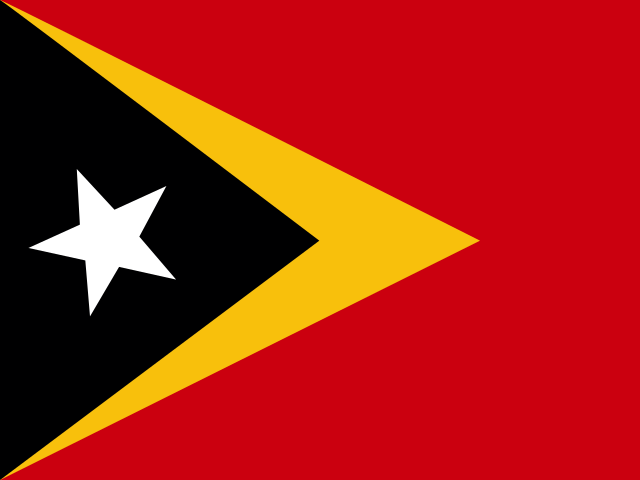
Flag of Timor-Leste
Yellow denotes the colonialism in Timor-Leste's past, black represents the obscurantism that needs to be overcome, red stands for the national liberation struggle.
The white star sits inside a black triangle nested in yellow. The black point stops before the yellow point does.
Compare with Cuba · Djibouti · São Tomé and Príncipe.
Languages and local life
Where the name comes from Timor" derives from the Indonesian and Malay word "timur" meaning "east"; "leste" is the Portuguese word for "east", so "Timor-Leste" literally means "Eastern-East"; the local [Tetum] name "Timor Lorosa'e" translates as "East Rising Sun".
Language profile Tetun Prasa 30.6%, Mambai 16.6%, Makasai 10.5%, Tetun Terik 6.1%, Baikenu 5.9%, Kemak 5.8%, Bunak 5.5%, Tokodede 4%, Fataluku 3.5%, Waima'a 1.8%, Galoli 1.4%, Naueti 1.4%, Idate 1.2%, Midiki 1.2%, other 4.5% (2015 est.).
Currency United States dollar (USD).
Borders and landscape
Area and borders Total area is about 14,874 km². It shares land borders with Indonesia.
Landscape Mountainous.
From high to low Highest point: Foho Tatamailau 2,963 m. Lowest point: Timor Sea, Savu Sea, and Banda Sea 0 m.
A person connected to this country
What they contributed “for their work towards a just and peaceful solution to the conflict in East Timor”
The person Carlos Filipe Ximenes Belo, born in Wailacama, received the 1996 Nobel Prize in Peace.
Where it is
On the map Timor-Leste shares Timor with Indonesia and also includes the Oecusse area, separated from the country's main territory.
Where people live Most of the population concentrated in the western third of the country, particularly around Dili.