
France
Metropolitan France extends from the Atlantic coast to the Mediterranean, taking in the western Alps along its border with Italy and Switzerland.
- Capital
- Paris
- Region
- Western Europe
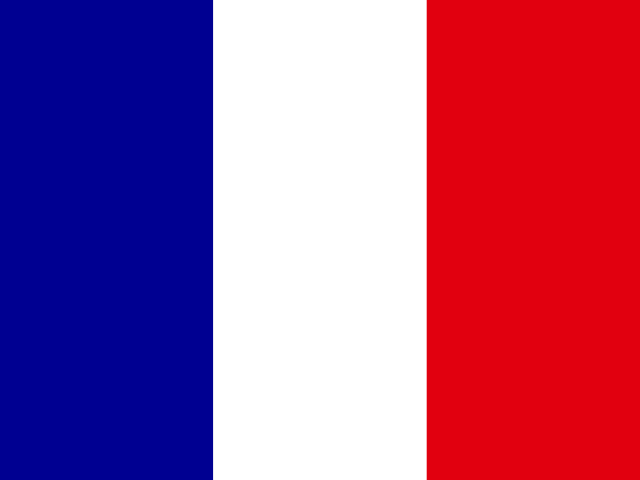
Flag of France
The tricolour emerged during the French Revolution. In 1794, the National Convention set the order of the vertical bands, placing blue at the hoist, white in the centre and red at the free edge.
Think upright blue–white–red. The Netherlands uses the same colours laid across the flag, with red at the top.
Compare with Italy · Mexico · Ivory Coast · Ireland.
Languages and local life
Where the name comes from Name derives from the Latin "Francia" meaning "Land of the Franks"; the Franks were a group of Germanic tribes located along the middle and lower Rhine River in the 3rd century A.D. who merged with Gallic-Roman populations in succeeding centuries and to whom they passed on their name.
Language profile French (official) 100%, declining regional dialects and languages (Provencal, Breton, Alsatian, Corsican, Catalan, Basque, Flemish, Occitan, Picard).
Currency Euro (EUR).
Borders and landscape
Area and borders Total area is about 551,695 km². It shares land borders with Andorra, Belgium, Germany, Italy, Luxembourg, Monaco, Spain and Switzerland.
Landscape Metropolitan France: mostly flat plains or gently rolling hills in north and west; remainder is mountainous, especially Pyrenees in south, Alps in east; French Guiana: low-lying coastal plains rising to hills and small mountains; Guadeloupe: Basse-Terre is volcanic in origin with interior mountains; Grande-Terre is low limestone formation; most of the seven other islands are volcanic in origin; Martinique: mountainous with indented coastline; dormant volcano; Mayotte: generally undulating, with deep ravines and ancient volcanic peaks; Reunion: mostly rugged and mountainous; fertile lowlands along coast.
From high to low Highest point: Mont Blanc 4,810. Lowest point: Rhone River delta -2 m.
A moment in its history
The event In May 1789, a financial crisis brought the Estates General together. In June, Third Estate representatives formed a National Assembly; in July, the Bastille fell. Those turns marked the beginning of the French Revolution and a profound reshaping of French politics and society.
How the revolution ended In November 1799, the Coup of 18 Brumaire ended the French Revolution, more than a decade after the Estates General met in 1789.
A person connected to this country
What they contributed “for the discovery of non-linear effects and autocatalysis in asymmetric organic synthesis”
The person Henri B. Kagan, born in Boulogne-Billancourt, received the 2026 Nobel Prize in Chemistry.
Where they worked Université Paris-Sud at the time of the award.
Where it is
On the map Metropolitan France extends from the Atlantic coast to the Mediterranean, taking in the western Alps along its border with Italy and Switzerland.
Where people live Much of the population is concentrated in the north and southeast; although there are many urban agglomerations throughout the country, Paris is by far the largest city, with Lyon ranked a distant second.