
Ireland
Ireland covers most of its namesake island, and the Shannon flows through the west of its central plain toward the Atlantic.
- Capital
- Dublin
- Region
- Northern Europe
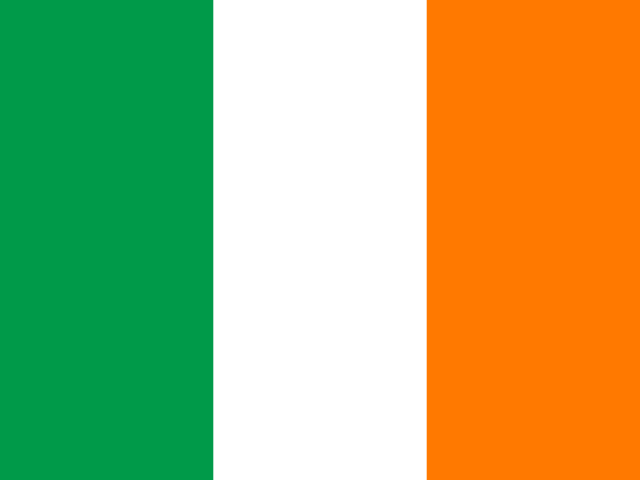
Flag of Ireland
Green represents the Irish nationalist tradition, orange the Protestant tradition, and white the hope of peace between them.
Read the stripes left to right. Ireland starts with green and ends in orange. Côte d’Ivoire starts with orange.
Compare with Italy · Mexico · Ivory Coast · France.
Languages and local life
Where the name comes from The modern Irish name "Eire" evolved from the Gaelic "Eriu," the name of the matron goddess of Ireland (goddess of the land); the names "Ireland" in English and "Eire" in Irish are direct translations of each other.
Language profile English (official, the language generally used), Irish (Gaelic or Gaeilge) (official, spoken by approximately 37.7% of the population).
Currency Euro (EUR).
Borders and landscape
Area and borders Total area is about 70,273 km². It shares land borders with United Kingdom.
Landscape Mostly flat to rolling interior plain surrounded by rugged hills and low mountains; sea cliffs on west coast.
From high to low Highest point: Carrauntoohil 1,041 m. Lowest point: Atlantic Ocean 0 m.
A person connected to this country
What they contributed “for their discoveries concerning a novel therapy against infections caused by roundworm parasites”
The person William C. Campbell, born in Ramelton, received the 2015 Nobel Prize in Physiology or Medicine.
Where they worked Drew University at the time of the award.
Where it is
On the map Ireland covers most of its namesake island, and the Shannon flows through the west of its central plain toward the Atlantic.
Where people live Population distribution is weighted to the eastern side of the island, with the largest concentration being in and around Dublin; populations in the west are small due to mountainous land, poorer soil, lack of good transport routes, and fewer job opportunities.