
Italy
Italy encompasses the long Apennine peninsula and neighbouring islands, including Sicily and Sardinia.
- Capital
- Rome
- Region
- Southern Europe
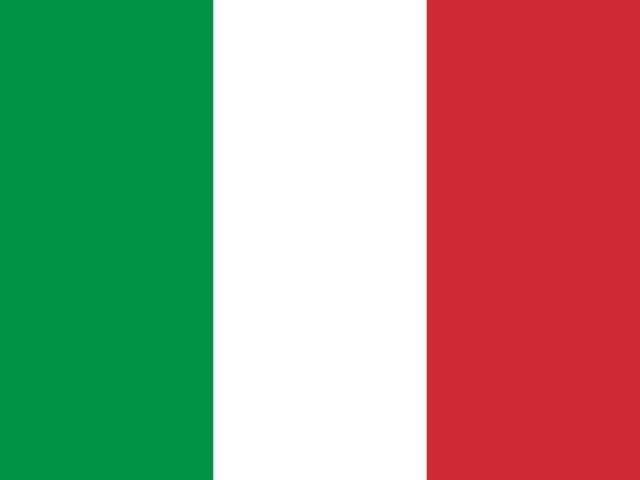
Flag of Italy
The tricolour dates to 1797, when the Cispadane Republic adopted green, white and red.
Mexico and Italy share vertical green–white–red. Check the white stripe: Italy leaves it empty, Mexico has an eagle.
Compare with Mexico · Ivory Coast · Ireland · France.
Languages and local life
Where the name comes from Derivation is unclear, but the Latin "Italia" may come from the Oscan "Viteliu" meaning "[Land] of Young Cattle" (the bull was a symbol of southern Italic tribes).
Language profile Italian (official), German (parts of Trentino-Alto Adige region are predominantly German-speaking), French (small French-speaking minority in Valle d'Aosta region), Slovene (Slovene-speaking minority in the Trieste-Gorizia area), Croatian (in Molise).
Currency Euro (EUR).
Food traditions
The tradition The Mediterranean diet includes the skills used to grow, preserve and cook food. Eating together is central to the tradition, creating occasions to pass on recipes and seasonal knowledge.
Learning at the market Markets help pass down knowledge as people trade and talk. The heritage also includes vessels and dishes made to carry, store and serve food.
Borders and landscape
Area and borders Total area is about 301,336 km². It shares land borders with Austria, France, San Marino, Slovenia, Switzerland and Vatican City.
Landscape Mostly rugged and mountainous; some plains, coastal lowlands.
From high to low Highest point: Mont Blanc (Monte Bianco) de Courmayeur (a secondary peak of Mont Blanc) 4,748 m. Lowest point: Mediterranean Sea 0 m.
A moment in its history
The event Italian unification resulted in the creation of the Kingdom of Italy in 1861.
The wider story Rome was captured in 1870 and officially designated capital in 1871. The kingdom’s creation, acquisition of the city and capital designation form three stages of the same wider unification process.
The Risorgimento Risorgimento means “resurgence”. The movement created a kingdom in 1861, and Rome became its capital in 1871.
Where it is
On the map Italy encompasses the long Apennine peninsula and neighbouring islands, including Sicily and Sardinia.
Where people live Despite a distinctive pattern with an industrial north and an agrarian south, a fairly even population distribution exists throughout most of the country, with coastal areas, the Po River Valley, and urban centers (particularly Milan, Rome, and Naples), attracting larger and denser populations.