
Namibia
Namibia's Namib Desert runs along an Atlantic coast, which can seem surprising if a sea automatically suggests a wet landscape. The cold Benguela Current helps bring fog to parts of that otherwise very dry coast. Farther south, the Orange River marks much of the border. Ocean, fog, desert and river are compatible clues rather than contradictory ones.
- Capital
- Windhoek
- Region
- Southern Africa
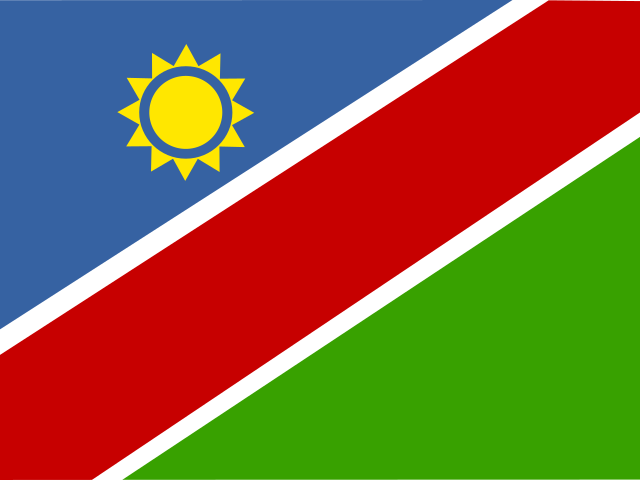
Flag of Namibia
Red signifies the heroism of the people and their determination to build a future of equal opportunity for all.
The sun is in the blue corner. A red diagonal cuts across to the green side, with thin white lines on both edges.
Compare with Tanzania · Trinidad and Tobago · Saint Kitts and Nevis · DR Congo · Solomon Islands.
Languages and local life
Where the name comes from Named for the coastal Namib Desert; the name "namib" means "vast place" in the Nama/Damara language.
Language profile Oshiwambo languages 49.7%, Nama/Damara 11%, Kavango languages 10.4%, Afrikaans 9.4%, Herero languages 9.2%, Zambezi languages 4.9%, English (official) 2.3%, other African languages 1.5%, other European languages 0.7%, other 1% (2016 est.).
Currency Namibian dollar (NAD) and South African rand (ZAR).
Food traditions
The tradition Communities gather during the marula harvest to prepare and share a drink made from the fruit. The work and celebrations pass on knowledge of the trees and strengthen ties between households.
Making omagongo The juice ferments in clay pots for two to seven days. Processing the fruit gives older and younger participants time to share songs and skills.
Borders and landscape
Area and borders Total area is about 825,615 km². It shares land borders with Angola, Botswana, South Africa and Zambia.
Landscape Mostly high plateau; Namib Desert along coast; Kalahari Desert in east.
From high to low Highest point: Konigstein on Brandberg 2,573 m. Lowest point: Atlantic Ocean 0 m.
Where it is
On the map Namibia's Namib Desert runs along an Atlantic coast, which can seem surprising if a sea automatically suggests a wet landscape. The cold Benguela Current helps bring fog to parts of that otherwise very dry coast. Farther south, the Orange River marks much of the border. Ocean, fog, desert and river are compatible clues rather than contradictory ones.
Where people live Population density is very low, with the largest clustering found in the extreme north-central area along the border with Angola.
A person connected to this country
The country’s first Olympic medals In Barcelona in 1992, Frankie Fredericks took silver in the 100 and 200 metres. Those were Namibia’s first Olympic medals.
Gold at the World Championships Fredericks won the world 200 metres title in 1993. At Atlanta in 1996, he repeated his Barcelona double, taking silver in both sprints again.