
Saint Kitts and Nevis
Saint Kitts and Nevis is the twin-island country west of Antigua, with Nevis just across a narrow channel from Saint Kitts.
- Capital
- Basseterre
- Region
- Caribbean
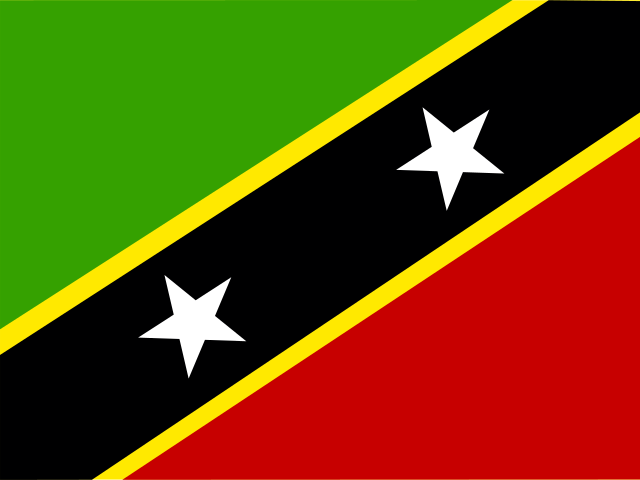
Flag of Saint Kitts and Nevis
Green signifies the island's fertility, red symbolizes the struggles of the people from slavery, yellow denotes year-round sunshine, and black represents the African heritage of the people.
Look for two white stars in the black diagonal. Tanzania also has a yellow-edged black diagonal, but leaves it empty.
Compare with Tanzania · Trinidad and Tobago · Namibia · DR Congo · Solomon Islands.
Languages and local life
Where the name comes from Saint Kitts was, and still is, referred to as Saint Christopher and this name was well established by the 17th century (although who first applied the name is unclear); in the 17th century a common nickname for Christopher was Kit or Kitt, so the island began to be referred to as "Saint Kitt's Island" or just "Saint Kitts"; Nevis is derived from the original Spanish name "Nuestra Senora de las Nieves" (Our Lady of the Snows) and refers to the white halo of clouds that generally wreathes Nevis Peak.
Language profile English (official).
Currency Eastern Caribbean dollar (XCD).
Borders and landscape
Area and borders Total area is about 261 km².
Landscape Volcanic with mountainous interiors.
From high to low Highest point: Mount Liamuiga 1,156 m. Lowest point: Caribbean Sea 0 m.
Where it is
On the map Saint Kitts and Nevis is the twin-island country west of Antigua, with Nevis just across a narrow channel from Saint Kitts.
Where people live Population clusters are found in the small towns located on the periphery of both islands.
A person connected to this country
Profile Kim Collins (born 5 April 1976) is a Kittitian former track and field sprinter. In 2003, he became the World Champion in the 100 metres.
From the biography “He competed at ten editions of the World Championships in Athletics, from 1995 to 2015, winning five medals.”