
Tanzania
Tanzania includes Kilimanjaro on the mainland near Kenya and Zanzibar offshore to the east.
- Capital
- Dodoma
- Region
- Eastern Africa
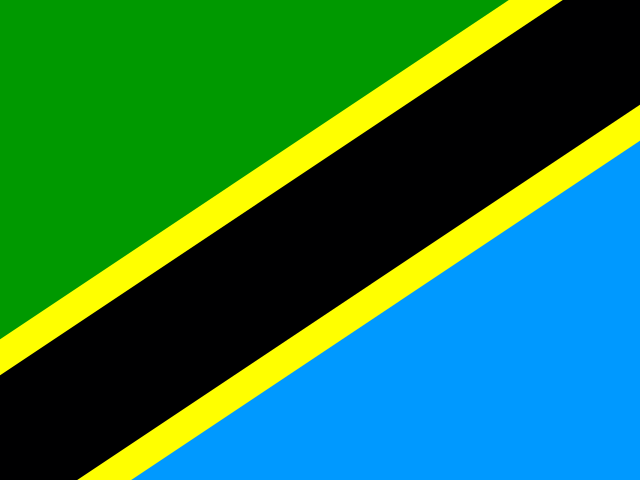
Flag of Tanzania
Green represents the natural vegetation of the country, gold its rich mineral deposits, black the native Swahili people, and blue the country's many lakes and rivers, as well as the Indian Ocean.
Look for a yellow-edged black diagonal with green above and blue below. Saint Kitts and Nevis puts two white stars on its diagonal.
Compare with Trinidad and Tobago · Saint Kitts and Nevis · Namibia · DR Congo · Solomon Islands.
Languages and local life
Where the name comes from The country's name is a combination of the first letters of Tanganyika and Zanzibar, the two states that merged to form Tanzania in 1964.
Language profile Kiswahili or Swahili (official), Kiunguja (name for Swahili in Zanzibar), English (official, primary language of commerce, administration, and higher education), Arabic, many local languages.
Currency Tanzanian shilling (TZS).
Borders and landscape
Area and borders Total area is about 945,087 km². It shares land borders with Burundi, DR Congo, Kenya, Malawi, Mozambique, Rwanda, Uganda and Zambia.
Landscape Plains along coast; central plateau; highlands in north, south.
From high to low Highest point: Kilimanjaro (highest point in Africa) 5,895 m. Lowest point: Indian Ocean 0 m.
Where it is
On the map Tanzania includes Kilimanjaro on the mainland near Kenya and Zanzibar offshore to the east.
Where people live The largest and most populous East African country; population distribution is extremely uneven, but greater population clusters occur in the northern half of country and along the east coast.
A person connected to this country
Profile Julius Kambarage Nyerere (Swahili: [ˈdʒulius kɑᵐbɑˈɾɑɠɛ ɲɛˈɾɛɾɛ]; 13 April 1922 – 14 October 1999) was a Tanzanian politician, anti-colonial activist, revolutionary and political theorist. He governed Tanganyika as prime minister from 1961 to 1962 and then as president from 1962 to 1964, after which he led its successor state, Tanzania, as president from 1964 to 1985.
From the biography “Ideologically an African nationalist and African socialist, he promoted a political philosophy known as Ujamaa.”