
Croatia
Croatia has a curving Adriatic coastline, and the Dalmatian coast is lined with islands separated by narrow channels.
- Capital
- Zagreb
- Region
- Southeast Europe
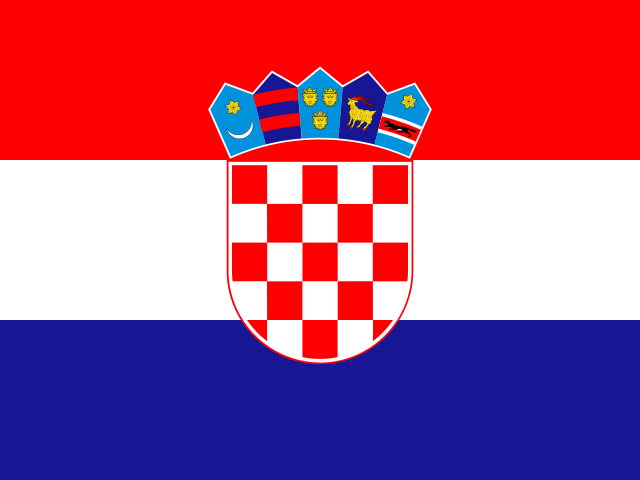
Flag of Croatia
The five small shields represent five historic regions (from left to right): Croatia, Dubrovnik, Dalmatia, Istria, and Slavonia.
The red-and-white checkerboard sits on the same stripe order as the Netherlands. Look for the row of little shields above it.
Compare with Netherlands · Luxembourg · Paraguay.
Languages and local life
Where the name comes from Name derives from the Croats, a Slavic tribe who migrated to the Balkans in the 7th century A.D.
Language profile Croatian (official) 95.2%, Serbian 1.2%, other 3.1% (including Bosnian, Romani, Albanian, and Italian) unspecified 0.5% (2021 est.).
Currency Euro (EUR).
Food traditions
The tradition The Mediterranean diet includes the skills used to grow, preserve and cook food. Eating together is central to the tradition, creating occasions to pass on recipes and seasonal knowledge.
Learning at the market Markets help pass down knowledge as people trade and talk. The heritage also includes vessels and dishes made to carry, store and serve food.
Borders and landscape
Area and borders Total area is about 56,594 km². It shares land borders with Bosnia and Herzegovina, Hungary, Montenegro, Serbia and Slovenia.
Landscape Geographically diverse; flat plains along Hungarian border, low mountains and highlands near Adriatic coastline and islands.
From high to low Highest point: Dinara 1,831 m. Lowest point: Adriatic Sea 0 m.
A person connected to this country
What they contributed “for his work on polymethylenes and higher terpenes”
The person Leopold Ruzicka, born in Vukovar, received the 1939 Nobel Prize in Chemistry.
Where they worked Eidgenössische Technische Hochschule (Swiss Federal Institute of Technology) at the time of the award.
Where it is
On the map Croatia has a curving Adriatic coastline, and the Dalmatian coast is lined with islands separated by narrow channels.
Where people live More of the population lives in the northern half of the country, with approximately a quarter of the populace residing in and around the capital of Zagreb; many of the islands are sparsely populated.