
Luxembourg
Luxembourg is the small country at the meeting point of those three neighbours, with the Moselle separating it from Germany in the southeast.
- Capital
- Luxembourg
- Region
- Western Europe
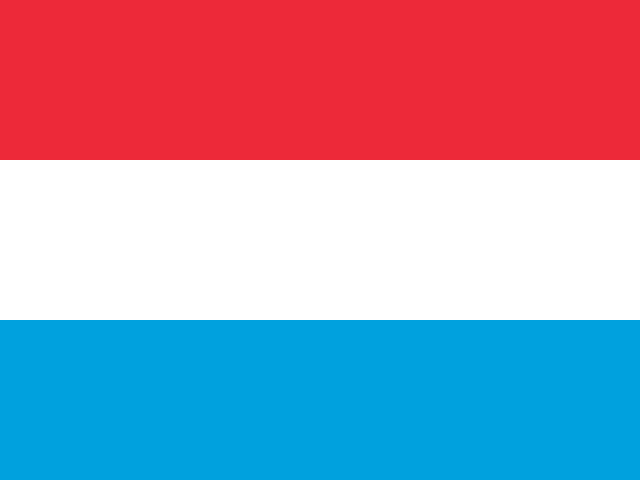
Flag of Luxembourg
The coloring is derived from the Grand Duke's coat of arms (a red lion on a white and blue striped field).
Compare the bottom stripe with the Netherlands. Luxembourg is sky blue there, the Netherlands uses a darker blue.
Compare with Netherlands · Croatia · Paraguay.
Languages and local life
Where the name comes from The name derives from the Celtic "lucilem" (little) and the German "burg" (castle or fortress) to produce the meaning of the "little castle"; the name is actually ironic, since for centuries the Fortress of Luxembourg was one of Europe's most formidable fortifications; the name passed to the surrounding city and then to the country itself.
Language profile Luxembourgish (official administrative, judicial, and national language) 48.9%, Portuguese 15.4%, French (official administrative, judicial, and legislative language) 14.9%, Italian 3.6%, English 3.6%, German (official administrative and judicial language) 2.9%, other 10.8% (2021 est.).
Currency Euro (EUR).
Borders and landscape
Area and borders Total area is about 2,586 km². It shares land borders with Belgium, France and Germany.
Landscape Mostly gently rolling uplands with broad, shallow valleys; uplands to slightly mountainous in the north; steep slope down to Moselle flood plain in the southeast.
From high to low Highest point: Buurgplaatz 559 m. Lowest point: Moselle River 133 m.
A person connected to this country
What they contributed “for their discoveries concerning the activation of innate immunity”
The person Jules A. Hoffmann, born in Echternach, received the 2011 Nobel Prize in Physiology or Medicine.
Where they worked University of Strasbourg at the time of the award.
Where it is
On the map Luxembourg is the small country at the meeting point of those three neighbours, with the Moselle separating it from Germany in the southeast.
Where people live Most people live in the south, on or near the border with France.