
Paraguay
Paraguay lies inland beside the Paraná, with the Gran Chaco on the western side of the country.
- Capital
- Asunción
- Region
- South America
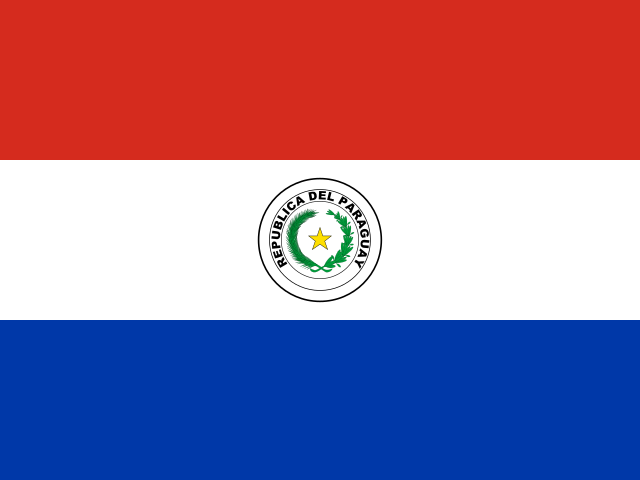
Flag of Paraguay
Red symbolizes bravery and patriotism, white represents integrity and peace, and blue denotes liberty and generosity.
Read it like the Netherlands’ red–white–blue, then look for a small emblem in the white stripe. Croatia’s checkerboard is larger.
Compare with Netherlands · Luxembourg · Croatia.
Languages and local life
Where the name comes from The precise meaning of the name Paraguay is unclear, but it seems to derive from the river of the same name; one explanation has the name meaning "water of the Payagua" (an indigenous tribe that lived along the river).
Language profile Spanish (official) and Guarani (official) 46.3%, only Guarani 34%, only Spanish 15.2%, other (includes Portuguese, German, other Indigenous languages) 4.1%, no response 0.4% (2012 est.).
Currency Paraguayan guaraní (PYG).
Borders and landscape
Area and borders Total area is about 406,752 km². It shares land borders with Argentina, Bolivia and Brazil.
Landscape Grassy plains and wooded hills east of Rio Paraguay; Gran Chaco region west of Rio Paraguay mostly low, marshy plain near the river, and dry forest and thorny scrub elsewhere.
From high to low Highest point: Cerro Pero 842 m. Lowest point: junction of Río Paraguay and Río Paraná 46 m.
Where it is
On the map Paraguay lies inland beside the Paraná, with the Gran Chaco on the western side of the country.
Where people live Most of the population resides in the eastern half of the country; to the west lies the Gran Chaco (a semi-arid lowland plain), which accounts for 60% of the land territory, but only 2% of the overall population.
A person connected to this country
Profile Augusto Roa Bastos (13 June 1917 – 26 April 2005) was a Paraguayan novelist and short story writer. As a teenager he fought in the Chaco War between Paraguay and Bolivia, and he later worked as a journalist, screenwriter and professor.
From the biography “Roa Bastos's life and writing were marked by experience with dictatorial military regimes.”