
Finland
Finland occupies the eastern side of the Gulf of Bothnia, with forest and lakes stretching across its interior.
- Capital
- Helsinki
- Region
- Northern Europe
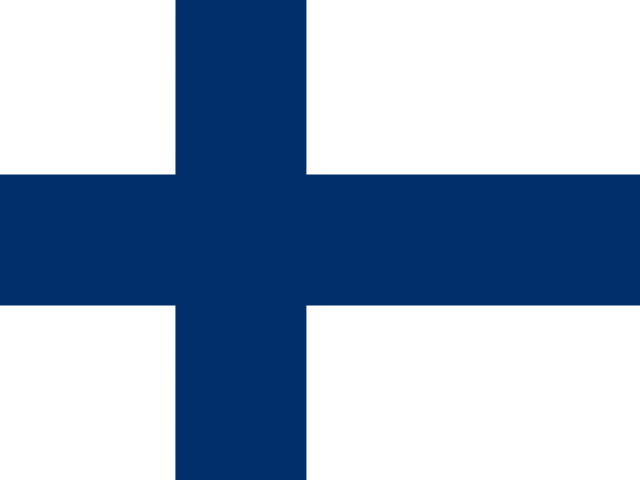
Flag of Finland
The blue Nordic cross evokes Finland’s lakes and the white field its winter snow.
The Nordic cross is blue and the background is white. Sweden keeps the cross shape but uses yellow on blue.
Languages and local life
Where the name comes from Name may derive from the ancient Fenni peoples who are first described as living in northeastern Europe in the first centuries A.D.
Language profile Finnish (official) 85.9%, Swedish (official) 5.2%, Russian 1.7%, other 7.2% (2022 est.).
Currency Euro (EUR).
Borders and landscape
Area and borders Total area is about 338,424 km². It shares land borders with Norway, Sweden and Russia.
Landscape Mostly low, flat to rolling plains interspersed with lakes and low hills.
From high to low Highest point: Halti (alternatively Haltia, Haltitunturi, Haltiatunturi) 1,328 m. Lowest point: Baltic Sea 0 m.
A person connected to this country
What they contributed “for their contributions to contract theory”
The person Bengt Holmström, born in Helsinki, received the 2016 Nobel Prize in Economic Sciences.
Where they worked Massachusetts Institute of Technology (MIT) at the time of the award.
Where it is
On the map Finland occupies the eastern side of the Gulf of Bothnia, with forest and lakes stretching across its interior.
Where people live The vast majority of people are found in the south; the northern interior areas remain sparsely populated.