
Sweden
Sweden extends east of Norway across the peninsula to the Baltic, where Gotland and Öland sit offshore.
- Capital
- Stockholm
- Region
- Northern Europe
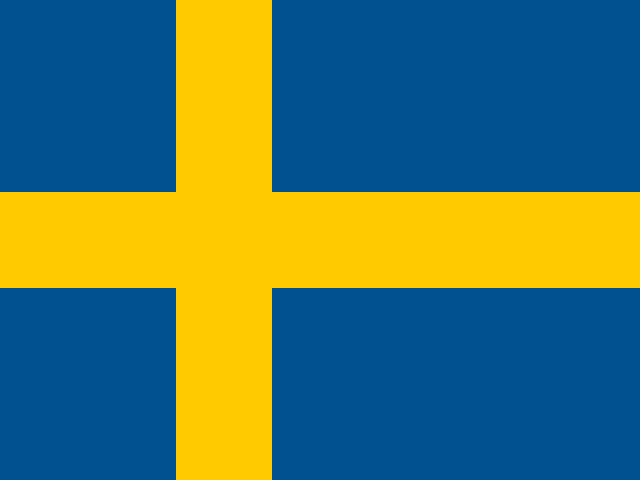
Flag of Sweden
Sweden’s flag law specifies a yellow cross on blue with shorter blue panels on the flagpole side. The same law defines both the rectangular flag and a three-tailed version.
Yellow cross on blue is Sweden. Finland also uses blue, but as its cross on white rather than as its background.
Languages and local life
Where the name comes from Name ultimately derives from the North Germanic Svear tribe, which inhabited central Sweden and is first mentioned in the first centuries A.D.
Language profile Swedish (official).
Currency Swedish krona (SEK).
Borders and landscape
Area and borders Total area is about 450,295 km². It shares land borders with Finland and Norway.
Landscape Mostly flat or gently rolling lowlands; mountains in west.
From high to low Highest point: Kebnekaise South 2,100 m. Lowest point: reclaimed bay of Lake Hammarsjon, near Kristianstad -2.4 m.
A person connected to this country
What they contributed “for his discoveries concerning the genomes of extinct hominins and human evolution”
The person Svante Pääbo, born in Stockholm, received the 2022 Nobel Prize in Physiology or Medicine.
Where they worked Max Planck Institute for Evolutionary Anthropology, Okinawa Institute of Science and Technology and Leipzig University at the time of the award.
Where it is
On the map Sweden extends east of Norway across the peninsula to the Baltic, where Gotland and Öland sit offshore.
Where people live Most Swedes live in the south where the climate is milder and there is better connectivity to mainland Europe; population clusters are found all along the Baltic coast in the east; the interior areas of the north remain sparsely populated.