
Iceland
Iceland sits on the Mid-Atlantic Ridge, where the landscape records a spreading plate boundary. At the surface, glaciers and active volcanoes occupy the same country; some volcanoes lie beneath ice. Vatnajökull, in the southeast, is a vast ice cap. Fire and ice are therefore overlapping parts of the island's physical geography, rather than separate postcard scenes.
- Capital
- Reykjavik
- Region
- Northern Europe
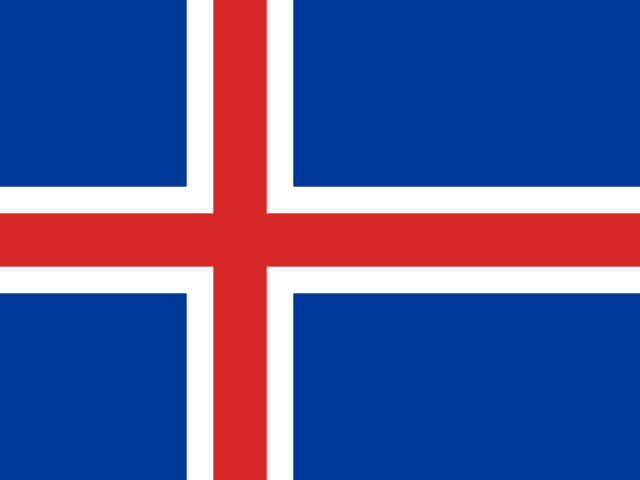
Flag of Iceland
The colors represent three of the elements that make up the island: red is for the island's volcanic fires, white recalls the snow and ice fields of the island, and blue is for the surrounding ocean.
Iceland has a red cross edged in white on blue. Norway swaps the two main colours, with its blue cross on red.
Languages and local life
Where the name comes from Floki VILGERDARSON, an early Norse explorer of the island (9th century), applied the name "Land of Ice" after spotting a fjord full of drift ice to the north and spending a bitter winter on the island; he eventually settled on the island, however, after he saw how it greened up in the summer and that it was, in fact, habitable.
Language profile Icelandic, English, Polish, Nordic languages, German.
Currency Icelandic króna (ISK).
Borders and landscape
Area and borders Total area is about 103,000 km².
Landscape Mostly plateau interspersed with mountain peaks, icefields; coast deeply indented by bays and fiords.
From high to low Highest point: Hvannadalshnukur (at Vatnajokull Glacier) 2,110 m. Lowest point: Atlantic Ocean 0 m.
A moment in its history
The event In Iceland’s May 1944 referendum, voters approved abolishing the union with Denmark and adopting a new republican constitution.
The wider story The earlier 1918 arrangement had already made Iceland a separate sovereign state while sharing Denmark’s king. The 1944 votes ended that personal union and chose a republican constitution: the change was more specific than simply becoming a country.
Two decisions on one ballot In May 1944 Icelanders voted both on ending their union with Denmark and on adopting a republican constitution. Both measures passed.
A person connected to this country
What they contributed “for his vivid epic power which has renewed the great narrative art of Iceland”
The person Halldór Laxness, born in Reykjavik, received the 1955 Nobel Prize in Literature.
Where it is
On the map Iceland sits on the Mid-Atlantic Ridge, where the landscape records a spreading plate boundary. At the surface, glaciers and active volcanoes occupy the same country; some volcanoes lie beneath ice. Vatnajökull, in the southeast, is a vast ice cap. Fire and ice are therefore overlapping parts of the island's physical geography, rather than separate postcard scenes.
Where people live Iceland is almost entirely urban with half of the population located in and around the capital of Reykjavik; smaller clusters are primarily found along the coast in the north and west.