
Norway
Norway occupies the mountainous western side of the peninsula, where the fjords open toward the North Atlantic.
- Capital
- Oslo
- Region
- Northern Europe
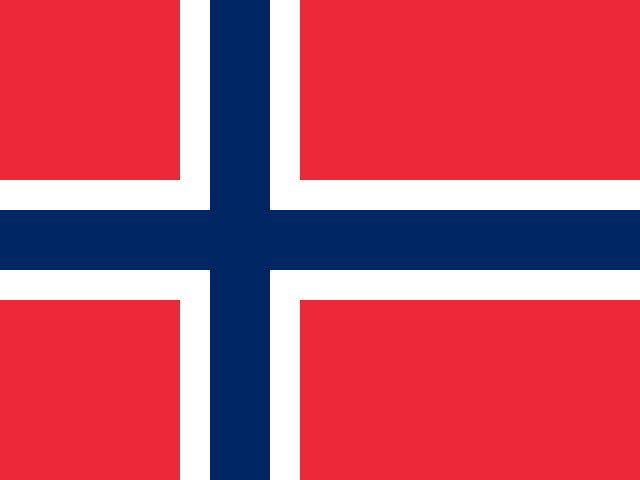
Flag of Norway
The Nordic cross reflects Norway’s regional ties. The red, white and blue were chosen as colours associated with liberty.
Think Denmark with a blue cross added inside the white one. Iceland puts its red cross inside white on a blue background.
Languages and local life
Where the name comes from Derives from the Old Norse words "nordr" and "vegr" meaning "northern way" and refers to the long coastline of western Norway.
Language profile Bokmal Norwegian (official), Nynorsk Norwegian (official), small Sami- and Finnish-speaking minorities.
Currency Norwegian krone (NOK).
Borders and landscape
Area and borders Total area is about 323,802 km². It shares land borders with Finland, Sweden and Russia.
Landscape Glaciated; mostly high plateaus and rugged mountains broken by fertile valleys; small, scattered plains; coastline deeply indented by fjords; arctic tundra in north.
From high to low Highest point: Galdhopiggen 2,469 m. Lowest point: Norwegian Sea 0 m.
A person connected to this country
What they contributed “for his innovative plays and prose which give voice to the unsayable”
The person Jon Fosse, born in Haugesund, received the 2023 Nobel Prize in Literature.
Where it is
On the map Norway occupies the mountainous western side of the peninsula, where the fjords open toward the North Atlantic.
Where people live Most Norwegians live in the south where the climate is milder and there is better connectivity to mainland Europe; population clusters are found all along the North Sea coast in the southwest, and Skaggerak in the southeast; the interior areas of the north remain sparsely populated.